
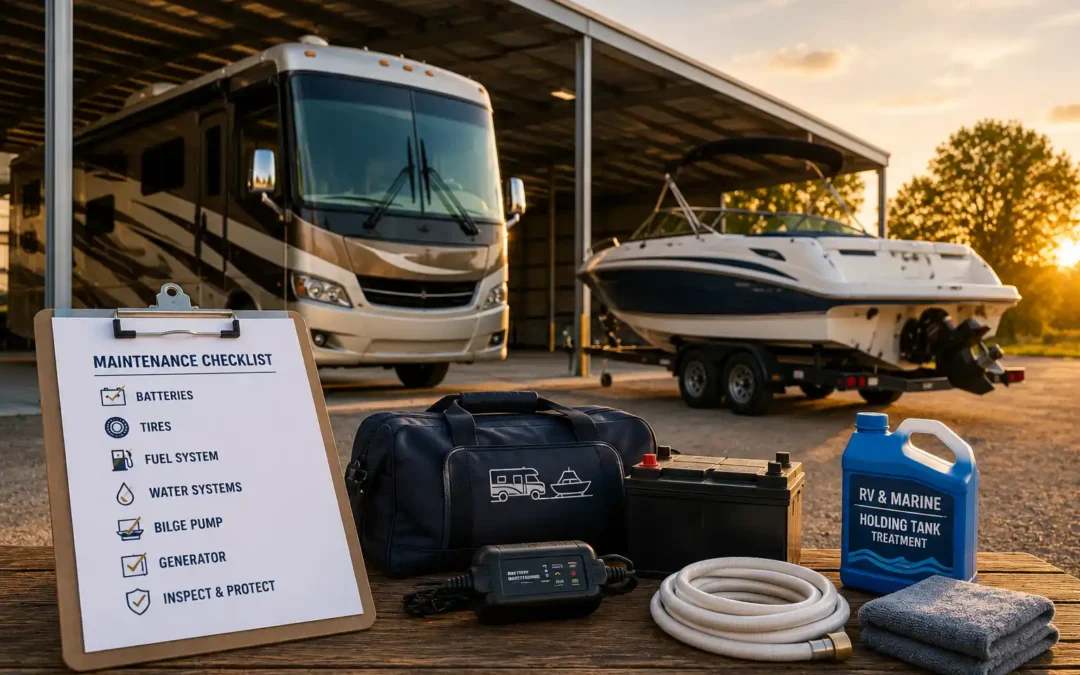
You bought your RV or boat to enjoy it. But life gets busy, schedules change, and sometimes several weeks or even months pass between adventures.
That raises an important question: How long can an RV or boat sit unused before you need to worry about it?
There’s no universal rule that says you need to take your RV on the highway or put your boat in the water every 30 days. In fact, repeatedly starting an engine for only a few minutes may do little to help. What’s more important is understanding what happens to batteries, fuel, tires, seals, generators, and other systems while your RV or boat sits.
With the right maintenance routine and a good storage environment, an RV or boat can remain unused for an extended period and still be ready when you are.
What Happens When an RV or Boat Sits Too Long?
An RV or boat doesn’t stop aging simply because you’re not using it.
Several things can happen during extended periods of inactivity:
- Batteries gradually discharge.
- Fuel can deteriorate.
- Tires lose pressure and may develop flat spots.
- Rubber seals and hoses can dry or crack.
- Moisture can accumulate inside.
- Pests may find their way into small openings.
- Corrosion can develop on electrical connections.
- RV generators can suffer from moisture and fuel-related issues.
How quickly these problems develop depends on the vehicle, storage conditions, weather, and how well it was prepared before being parked.
That’s why it’s better to think in terms of inspection intervals rather than simply starting your RV or boat every few weeks.
If It Has Been Sitting for 30 Days
A month isn’t particularly long for a properly stored RV or boat, but it’s still worth performing a quick inspection.
Check the Batteries
Both RVs and boats contain electrical systems that can continue drawing small amounts of power even when everything appears to be turned off. These are sometimes called parasitic loads.
Over several weeks, those small loads can significantly discharge a battery.
For an RV that will remain parked, a battery disconnect switch or appropriate battery maintainer may be useful. Battery type matters, however. Lead-acid and lithium batteries have different storage requirements, so always follow the battery manufacturer’s instructions.
Go RVing recommends using a maintainer or trickle charge to prevent self-discharge when appropriate and notes that lithium batteries require different storage practices.
Read Go RVing’s RV battery and storage recommendations.
Boat batteries deserve the same attention. Discover Boating recommends a maintenance-type charger for boats that are used infrequently.
Learn more about marine battery care from Discover Boating.
Look for Leaks and Moisture
Walk around the RV or boat and look for anything that has changed since you parked it.
For an RV, check around:
- Roof seams
- Windows
- Slide-outs
- Vents
- Air conditioners
- Exterior storage compartments
Inside, pay attention to musty odors or signs of moisture.
Boat owners should inspect the bilge, compartments, canvas, upholstery, and other areas where water could accumulate.
A five-minute inspection can sometimes catch a small leak before it becomes an expensive repair.
If It Has Been Sitting for 60 Days
Once you’re approaching two months without use, spend a little more time checking mechanical and storage-related components.
Pay Attention to Fuel
Fuel doesn’t remain unchanged indefinitely.
This can be particularly important for boats. Discover Boating notes that many common marine engine problems are related to either fuel or batteries and recommends marine-specific fuel stabilizer during extended periods of non-use.
See Discover Boating’s beginner boat maintenance recommendations.
Don’t automatically add products or drain fuel based on a generic rule. Requirements differ among gasoline, diesel, carbureted, fuel-injected, marine, and RV engines. Follow the engine manufacturer’s storage recommendations.
Inspect Tires
Tires deserve attention even when they aren’t rolling.
RV and boat trailer tires carry significant weight while parked. Check:
- Inflation pressure
- Sidewall cracking
- Bulges
- Uneven deterioration
- Valve stems
Don’t intentionally lower tire pressure simply because a vehicle is being stored. Goodyear recommends maintaining the vehicle manufacturer’s recommended inflation pressure during storage.
For vehicles stored for extended periods, Goodyear also recommends moving the vehicle periodically to help prevent weather checking and flat spotting. Its tire-storage guidance recommends movement at least every three months for most stored vehicles.
Review Goodyear’s tire storage recommendations.
This is also a good reason to periodically inspect an RV or boat even when you aren’t planning to use it.
If It Has Been Sitting for 90 Days or Longer
Once your RV or boat has been parked for several months, treat the next outing more like a return-to-service inspection.
Before heading out, check:
- Tires and tire pressure
- Batteries
- Engine fluids
- Fuel system
- Brakes
- Trailer connections
- Lights
- Water systems
- Safety equipment
- Seals and hoses
Boat owners should also test navigation lights, electronics, and the bilge pump before launching.
Discover Boating recommends inspecting batteries, lights, pumps, electronics, and fuel-system components when preparing a boat to return to service.
See the Discover Boating commissioning checklist.
What About Your RV Generator?
The generator is one component where regular exercise can genuinely matter.
RV generators can sit unused for months, particularly when an RV is connected to shore power or stored between trips.
For gasoline-powered Cummins Onan RV generators, the manufacturer has historically recommended exercising the generator for approximately two hours every four weeks at a minimum 50% load. This helps keep moving components lubricated, remove moisture, and reduce fuel varnishing.
That doesn’t mean every RV generator follows the same schedule. Diesel units and newer generator models may have different requirements.
Always check the owner’s manual for your specific generator.
The broader point is important: running a generator under an appropriate load is very different from simply starting it for five minutes.
Should You Periodically Start Your Boat Engine?
This is another area where generic advice can cause confusion.
Simply starting a boat engine briefly while it’s sitting isn’t necessarily beneficial, and many marine engines require a proper cooling-water supply when operated out of the water.
Rather than following a universal “start it every month” rule, follow the storage procedure recommended by your engine manufacturer.
More important during periods of non-use are:
- Maintaining the battery
- Protecting the fuel system
- Inspecting fuel lines
- Checking for corrosion
- Keeping the boat clean and dry
Discover Boating notes that most outboard, sterndrive, and gasoline inboard engines require basic service approximately every 100 operating hours or annually, although the manufacturer’s maintenance schedule should always take priority.
Read more about boat engine maintenance.
Don’t Forget About Your Boat’s Bilge Pump
If your boat is stored outdoors or anywhere water could enter the hull, the bilge deserves special attention.
The bilge is the lowest interior area of the hull where water naturally collects. A bilge pump removes that water before it becomes a larger problem.
Periodically inspect:
- Bilge water level
- Pump operation
- Float switch
- Battery condition
- Discharge hose
A boat with an automatic bilge pump still depends on a functioning electrical system, which is another reason battery maintenance matters during extended storage.
RV Water and Waste Systems Need Attention Too
If your RV will sit unused for an extended period, don’t forget about its plumbing and holding tank systems.
Most RVs have three primary holding tanks:
- Fresh water tank: stores clean water for drinking, cooking, washing, and other uses.
- Gray water tank: collects wastewater from sinks and showers.
- Black water tank: holds waste and water from the toilet.
Don’t leave waste sitting in the black or gray tanks for months. Empty and properly rinse the tanks according to your RV manufacturer’s recommendations. Fresh water also shouldn’t simply be forgotten during a long period of non-use. Depending on how long the RV will be stored, the freshwater system may need to be drained, sanitized, or winterized before it’s used again.
If you’re new to RV holding tanks, our RV and boat owner’s vacation checklist explains the differences between fresh, gray, and black water tanks and covers some of the basic maintenance to perform before your next trip.
If the RV will sit through freezing weather, additional winterization may also be required to prevent damage to tanks, water lines, pumps, and fittings. Our off-season RV and boat storage checklist covers draining RV water systems and other steps to prepare for longer periods of storage.
Check the Interior Even When You’re Not Traveling
Mechanical components aren’t the only things affected by inactivity.
A closed RV or boat can develop:
- Condensation
- Mold and mildew
- Musty odors
- Pest problems
- Upholstery deterioration
Remove food and other materials that could attract rodents or insects. Check cabinets, storage compartments, cushions, and corners periodically.
If you’re using moisture absorbers or a dehumidification system, inspect them regularly rather than assuming they’re still working months later.
Storage Conditions Make a Difference
Where your RV or boat sits matters almost as much as how long it sits.
An RV or boat stored outside in direct North Texas sunlight experiences a very different environment from one kept beneath a canopy or inside an enclosed space.
Direct exposure can mean more:
- UV radiation
- Heat
- Rain
- Hail
- Dust and debris
- Bird droppings
- Weather-related deterioration
Stover Creek offers outdoor, canopy, three-sided, and enclosed options for RV and boat storage in Celina, Texas, allowing owners to choose a level of protection appropriate for their vehicle and budget.
We’ve also covered the differences in our guide to choosing between enclosed, three-sided, and canopy storage.
A Simple 30-, 60-, and 90-Day Routine
You don’t necessarily need to take your RV on a road trip or launch your boat simply because another month has passed.
Instead, develop a routine.
Around 30 days: Check batteries, moisture, tire pressure, and signs of leaks or pests.
Around 60 days: Give tires, fuel systems, electrical connections, seals, and exterior surfaces a closer inspection.
Around 90 days: If the RV or boat has remained unused, perform a more thorough inspection and follow manufacturer recommendations for long-term storage and return to service.
These aren’t rigid mechanical service intervals. They’re practical reminders designed to keep “out of sight, out of mind” from becoming an expensive mistake.
The Bottom Line: It Doesn’t Have to Move, But It Does Need Attention
There’s no single answer to how often you should use an RV or boat.
A well-prepared RV or boat can sit for months without being driven or launched. The key is making sure “not being used” doesn’t also mean “not being maintained.”
Check batteries. Monitor tires. Protect fuel systems. Look for moisture. Exercise equipment when the manufacturer recommends it. And before returning to the road or water after an extended period, perform a thorough inspection.
A little attention while your RV or boat is parked can make the difference between “Let’s go!” and “Why won’t this thing start?”
And that’s a much better way to begin your next adventure.